

What’s the Deal with Saints?
‘The first millennial saint. . .’ Perhaps you’ve seen these words this past year as the Vatican declared a young man named Carlo Acutis, who was born in 1991 and lived to the age of fifteen, a saint. But what exactly does that mean and why does anyone even care?
Saints are definitely a familiar part of being Roman Catholic. If you look at a Roman Catholic liturgical calendar, you will find saint feast days and memorials on almost every day of the week. Parents often name their children after saints, and when a person receives the sacrament of Confirmation, it is part of tradition to choose and learn about a particular saint. I remember choosing Saint Lucy of Syracuse for my Confirmation, a saint familiar to Lutheran tradition as well as Catholic, mostly because of my fascination with her martyrdom but also because of her special connection as the patron of vision disabilities. With all the saints floating about, it is easy to become confused as to why we have saints in the first place.
Perhaps you’ve lost an item and your Catholic friend has ‘prayed to St. Anthony’ to help you find it. The language Catholics use regarding saints can be misleading and sometimes confusing. The word ‘saint’ comes from the Latin, sanctus, meaning ‘holy’, but going deeper, it holds a connotation of setting aside for God. A saint is a person who has lived his or her life for God. With that in mind, Catholics understand saints as being in heaven and with God, which means when a Catholic prays to a particular saint, it is to ask for that saint’s intercession, sometimes for something specific like finding your lost car keys. But the saints offer the everyday Catholic person something much more than this intercession.
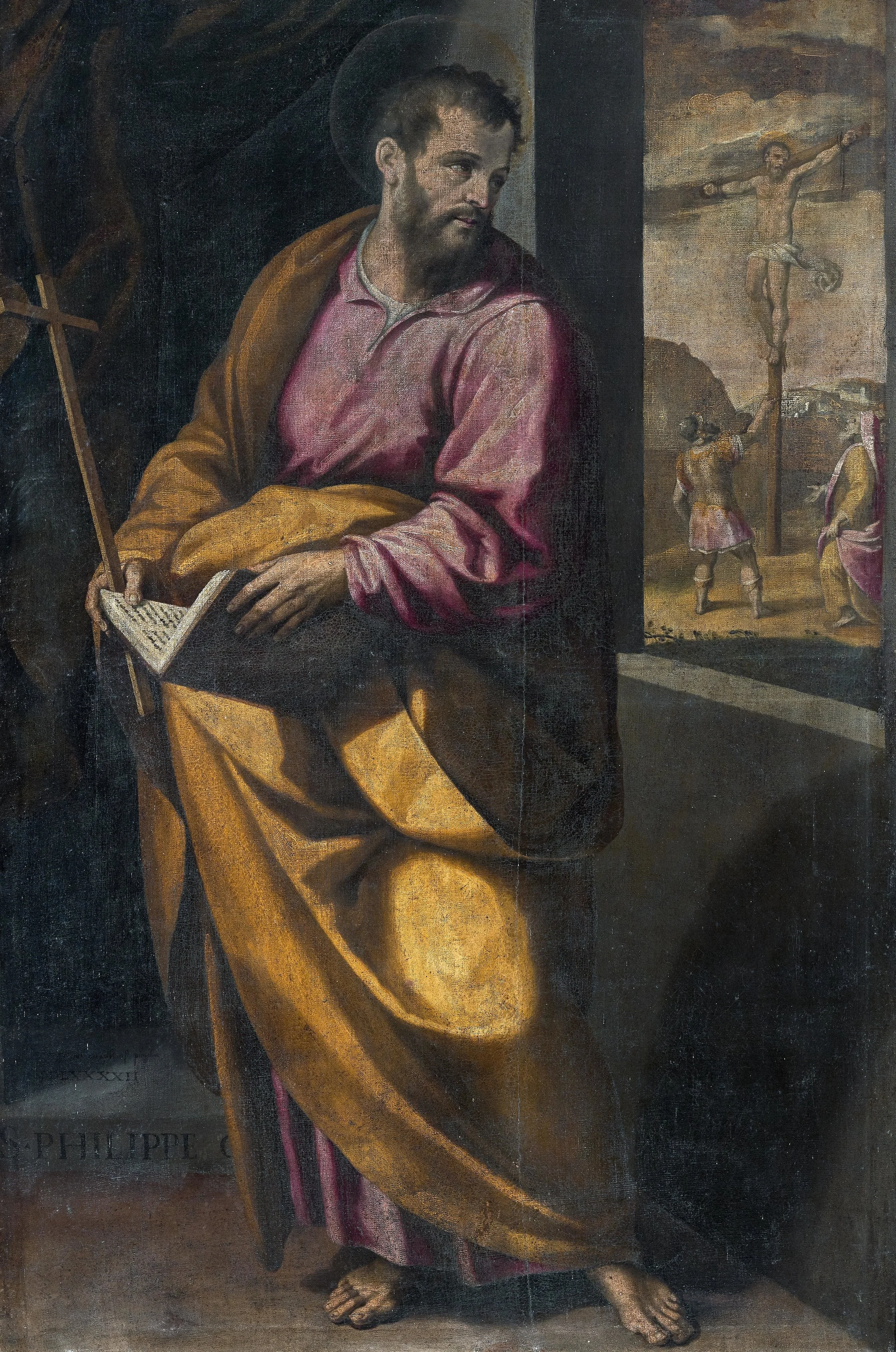
Felice Damiani (Italian, 1530-1608)
In Catholic teaching, every person is called to live for God and is therefore called to be a saint. If you’re like me, this sounds like a big ask. How do I become a saint when I’m struggling to manage working a full-time job, having a healthy social life, and taking care of my personal home life and chores? The lives of the saints offer help. The reality of every saint who has walked this earth is that they were in fact incredibly human. Meaning that despite the title and the reverence people give to Saint Carlo Actuis, for example, he still lived like I do today. He enjoyed video games and spending time with friends. This is one example, but many saints reveal humanity. Another example is one of my personal favorite saints, Saint Philip the Apostle, who spent time with Jesus every day and yet when Jesus asked him how they might feed a crowd of 5,000 people, Philip answers both pragmatically and with what I tend to think of as doubt: “Two hundred days’ wages[e] worth of food would not be enough for each of them to have a little [bit]” (John 6:7 New American Bible Revised). If you’re not familiar with this Bible passage, Jesus then proceeds to miraculously feed everyone and have lots of leftovers. The point is that Philip still struggles with what many of us can struggle with, and yet he still became a saint.
Every saint has something in common that we can learn from: a solid relationship with Jesus. St. Philip’s relationship with Jesus is clear, partly because he lived at the same time as Jesus. But every saint has that relationship. And when you look generally at the relationship saints have with Jesus, one thing starts to become obvious. The same humanity that makes a saint relatable to you and me is also present in each saint’s relationship with Jesus. The saints remind us to be honest and authentic about who we are while also striving to know Jesus better. Their importance comes more from how Jesus uplifted their humanity. It is the saints who inspire me to keep striving to live the life of a Christian and to continue to seek God.
*This article was originally published in the Post Bulletin.