

St. John the Evangelist, the Patron Saint of Our Parish
In the wake of Christmas, on December 27, we celebrate the feast of St. John the Evangelist, the patron saint of our parish. Jesus chose John, along with his brother James, Galilean fishermen, to be among his Twelve Apostles. He called the two brothers the “sons of thunder.” John was the youngest of all the disciples and was “the disciple whom Jesus loved,” forming a close relationship with the Virgin Mary.
John was present at many pivotal moments in Jesus’s life. He witnessed the Transfiguration, sat closest to Jesus during the Last Supper, and was an eyewitness to Jesus’s arrest in the Garden of Gethsemane. Of all the disciples, John alone remained with the Virgin Mary at the foot of the cross during Jesus’ crucifixion. It was there that Jesus entrusted his mother Mary into John’s care. Speaking from the cross, Jesus said, “Woman, behold your son.” Then he said to the disciple, “Behold, your mother.” From that hour, the disciple took her into his home (John 19:26–27), establishing a new spiritual family and a deep bond of love and responsibility for all believers.
Church tradition holds that John and Mary eventually settled in Ephesus—an ancient city in Turkey’s Central Aegean region—one of the earliest Christian communities. It was there that John is believed to have written his Gospel and four other books of the New Testament. John’s Gospel differs markedly from those of Mark, Luke, and Matthew, presenting Jesus with greater authority and radiant divinity. It is the only Gospel to omit a narrative of Jesus’s birth. Tradition holds that John died of old age, in his nineties, making him the only Apostle not to have suffered martyrdom.
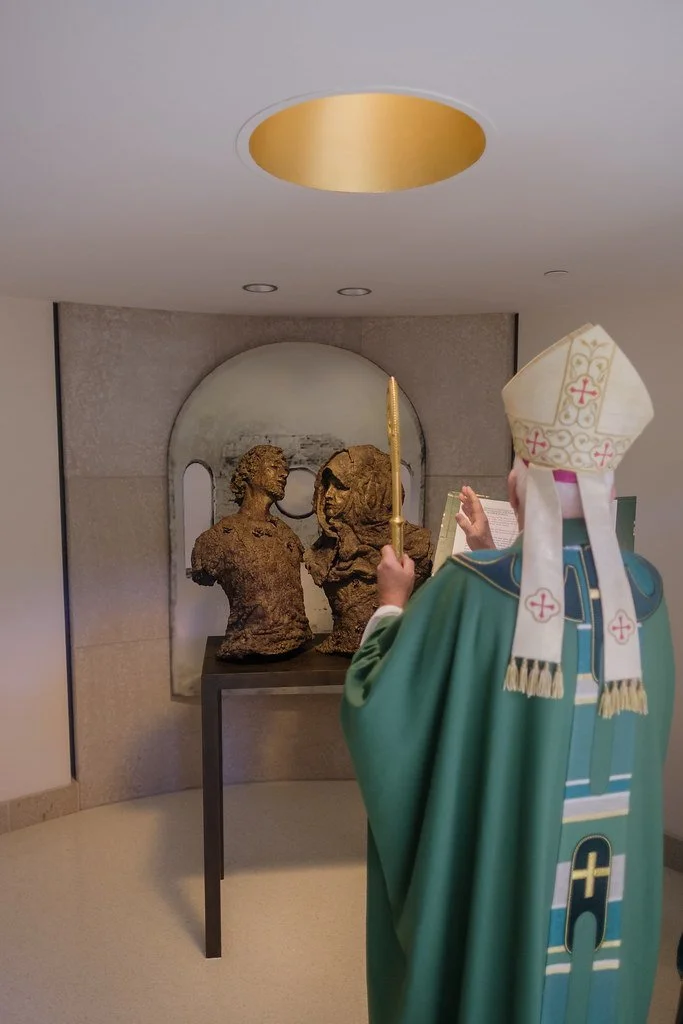
Bishop Quinn blesses the sculpture, John and Mary, in 2019.
Drawing on this tradition, in 2016 the Californian artist Simon Toparovsky was commissioned to design and create a sculpture depicting John the Evangelist and Mary, the Mother of Jesus, together after the Resurrection. The work emphasizes the closeness of their relationship as they lived together, caring for one another as the dying Christ had called them to do from the Cross. The shrine is located in the side chapel near the baptismal font. Intended for private meditation and liturgical instruction, the sculpture was unveiled in July 2019, one year after the Church of St. John the Evangelist was elevated to the dignity of a Co-Cathedral.
The sculpture, John and Mary, is set before an architectural structure representing a holy home, inspired by a depiction of an altar dedicated to Mary that was excavated during the construction of the oldest basilica in Milan, Italy, in the 4th century. A light descending from the ceiling signifies a portal to heaven, symbolizing the power and love of God. According to Simon Toparovsky, John is experiencing the light of the Lord, swelling with love and promise, symbolized by small flowers emerging from his heart and chest. Mary, portrayed as middle-aged and reflective, is deeply moved and raptured by the light of the Lord. Beneath her veil, a spray of flowers represents her courage and hope for the world. Together, John and Mary are depicted in a mysterious connection, sharing their love for the Lord.
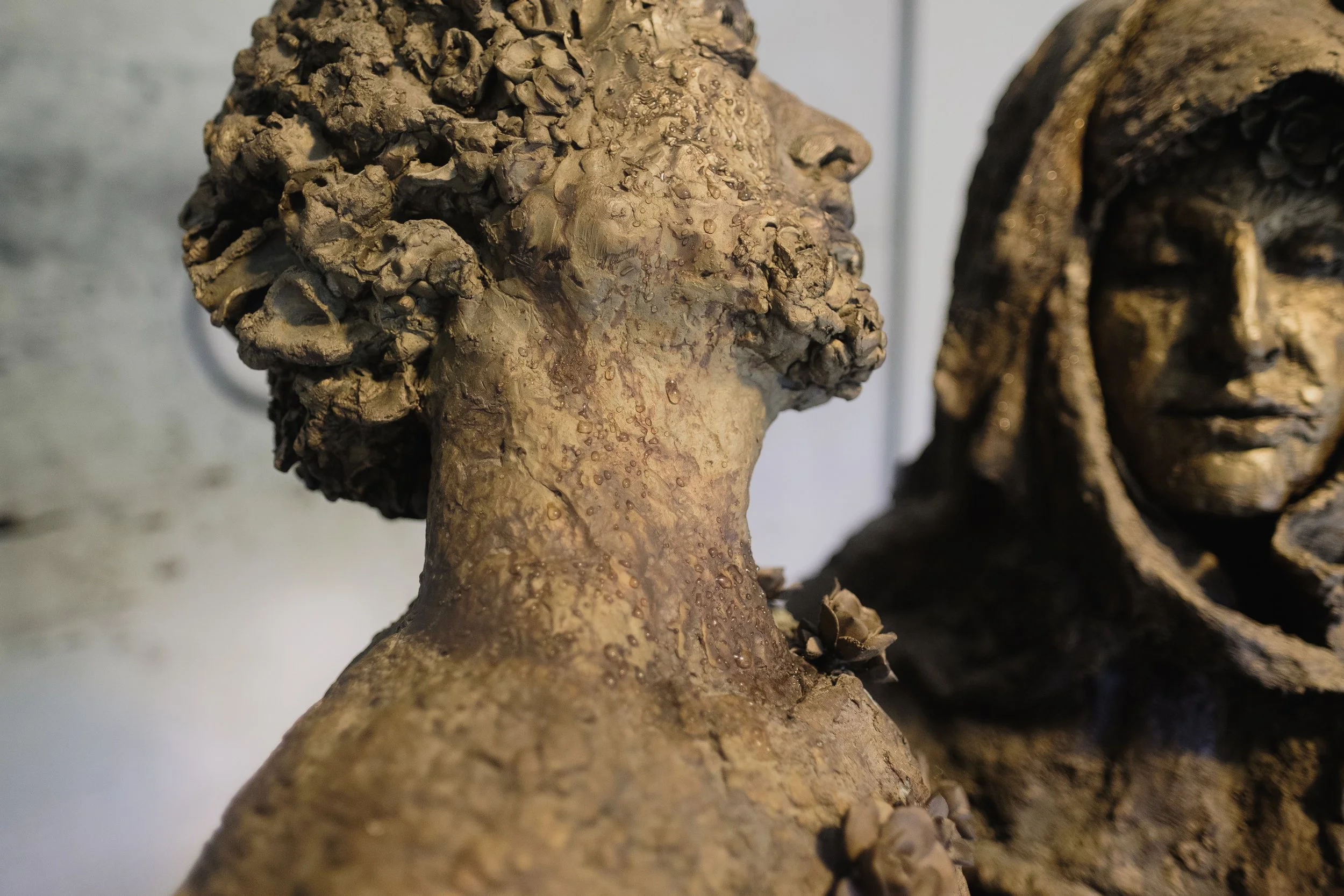
John and Mary Sculpture
John and Mary is one of two significant works by Simon Toparovsky in St. John’s permanent collection. He also created the tapestry Transitus, which has been displayed in our gathering space since 2020. Transitus is one of several Co-Cathedral artworks featured in the recently launched St. John’s film series CREATED, which invites viewers to rediscover and learn more about our church, its history, and its art. We invite you to visit createdfilmseries.com, where a new episode is released every two weeks, exploring St. John’s artworks, their artists, and their meaning.