
An Encounter with St. Benedict
I first encountered St. Benedict as a freshman in college. To satisfy my love of reading, I had enrolled in The Great Conversation program at my college, a sequence of five courses where we read through the classic texts of Western Civilization, starting with the first writing known to history, the Epic of Gilgamesh, and culminating with The Hobbit. In between, my cohort read history, philosophy, treatises, plays, large portions of the Old and New testaments, theologians, novels, and the tiny book that is the Rule of St Benedict.
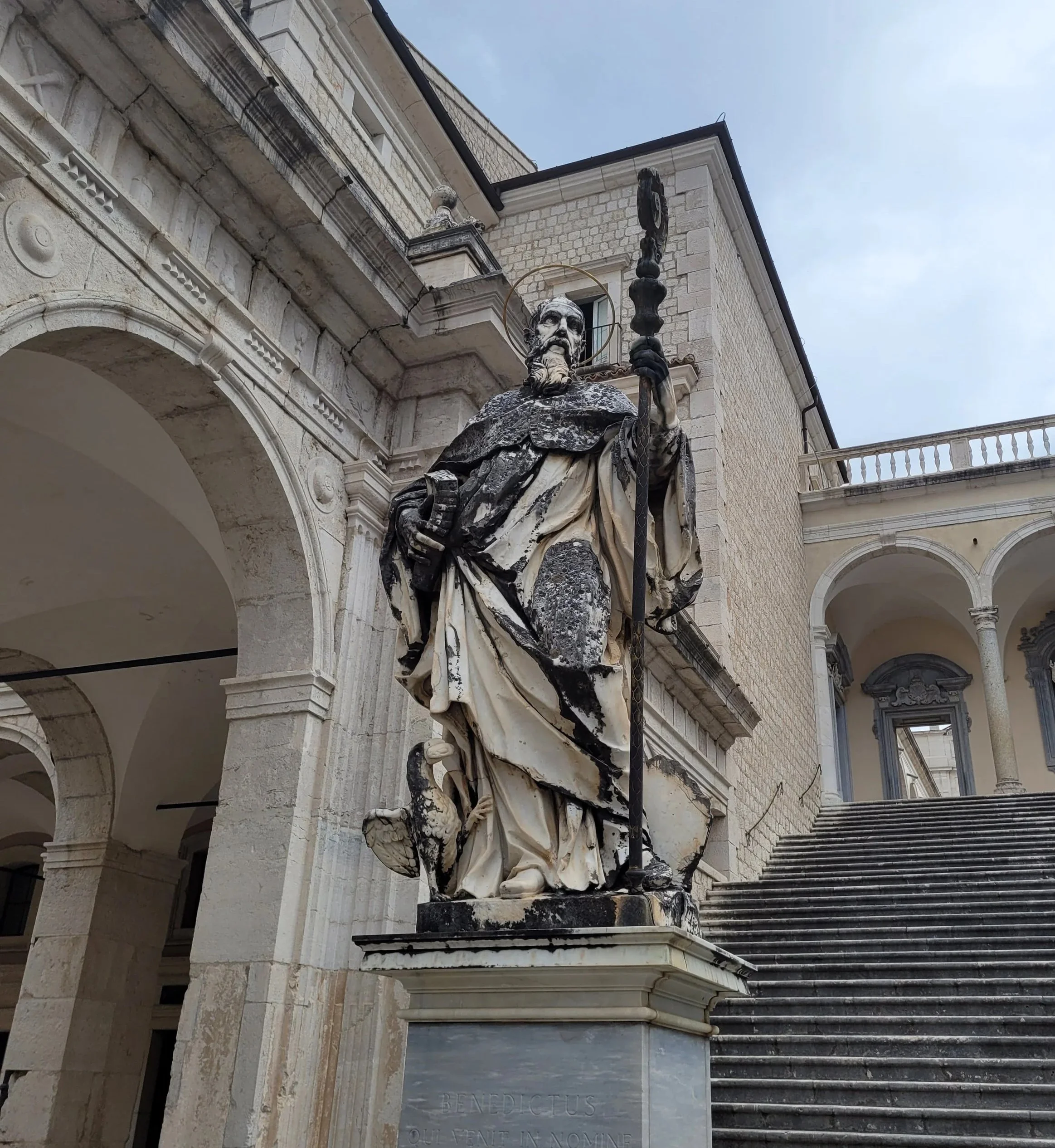
Statue of St. Benedict at the Montecassino Abbey in Italy
We know St. Benedict as a person in two ways…through his rule, which he wrote over a few decades in the early-mid 500s AD, and through the second book of the dialogues of Pope St. Gregory the Great, which details Benedict’s life through a series of miracles brought about through his prayers. Pope St. Gregory died around 600 AD, and though he is a few decades removed from being able to know St. Benedict in person, he did know monks who had known Benedict - Gregory specifies these monks by name, and he recommends the Rule explicitly.
I am going to mostly focus the things we can learn from the Rule of St. Benedict, since that is primarily how he has been at work in my life, but there is one thing that I wanted to point out about the miracles that happen in the life of St. Benedict written by Pope St. Gregory. The vast majority of the miracles are performed by his monks, while he, the “man of God”, is praying.
His Rule was written after he was an established Abbot, with much experience in the successes and failures of communities. The picture painted in the Dialogues of Benedict the pray-er among the worker-monks points to the wise elder that he became. So then, what did he pass down to us in his rule? What astonishing things did he have to say that thousands around the world have hung on his words for over 1500 years?
The main reason, I think, that the Rule of St. Benedict was so applicable throughout the past 1500 years can be summed up in one word: St. Benedict is practical. Many modern commentators mention this in a variety of different ways, praising his moderation, his discretion, his balance, his via media, his middle path between extremes of austerity or laxity, the flexibility he gives to the Abbot to make the rule livable. Benedict took in all his life experience, all the experience he could gain by reading how monks of prior centuries had done things and boiled it all down to the essentials.
The Rule is eminently about the practical nature of communal life, about how to balance daily demands, everything is done with moderation and counsel, all physical needs are provided for, helpers needed for tasks are provided, schedules are varied based on the seasons of the year, food quantity and quality is varied based on labor needs, job assignments are matched to qualifications, time is set aside for bathroom breaks, monks are told to encourage one another when sleepy, there are set rituals for returning to community after tensions erupt, and a basic healthy physical balance of alternating between hours of reading, singing, working, eating, and sleeping is established.
Overall, Benedict was creating a Rule so that Christians could have guidance on how practically to live out their Christianity. If there is a precept in the Gospel, Benedict likely has a practical situation where the monks are given an opportunity to put it into practice, or it is simply built in. Those in monasteries in those early centuries were not seeking to live anything but an ordinary gospel-oriented life. There was no theology of a “monastic vocation” back then and so an ordinary gospel-oriented life is what Benedict was legislating for them.
This resonates immensely. I am a Christian, seeking to live a gospel-oriented life, living every day with Jesus right now. St. Benedict reminds me that this is a truly whole-person practical endeavor. It is concerned with wake-up times, how much and what food I eat, if I have enough physical activity in my life, if my work is too stressful and I am not given support, if I take sufficient time in the day to praise God and sit with his Word. Our lives on a practical level will probably look wholesome once we have taken the time to follow Benedict’s advice and infuse some balance into them. These things take both planning, as in literally thinking about how many hours in a week each aspect of my life needs in order for it to be balanced and sustainable, as well as flexibility.
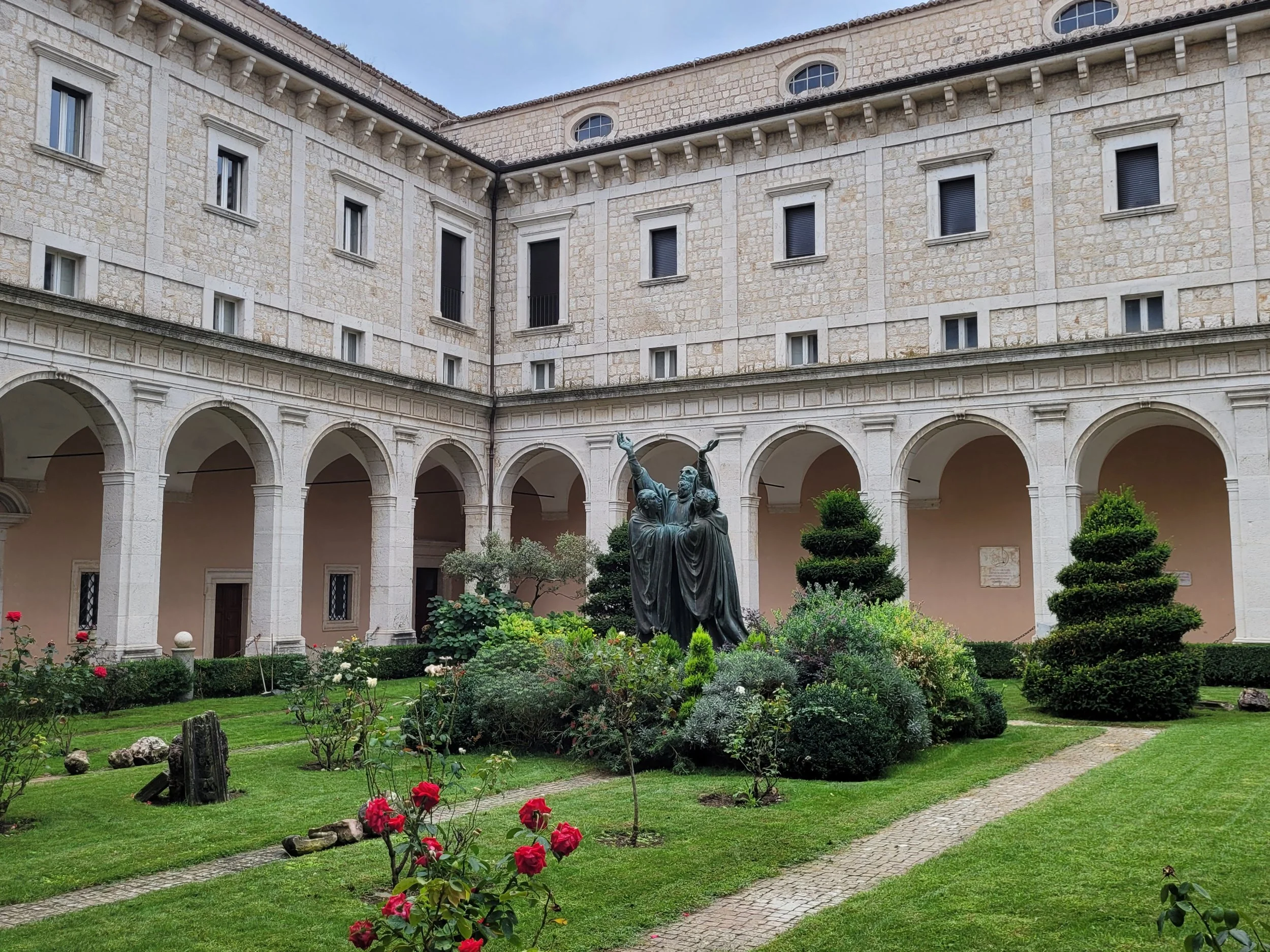
Montecassino Abbey in Italy
St. Benedict also has a long list of practical and spiritual “tools” for daily use, beginning with the great love commandments, the Ten Commandments, and moving on to precepts like visiting the sick, burying the dead as well as attitudinal adjustments like never giving a hollow greeting of peace, refraining from laziness, settle disputes before the sun goes down, place your hope in God alone, etc. all through 74 total tools and finally, the last one: never lose hope in God’s mercy. Benedict also offers the traditional motivation for using these practical and spiritual tools associated with medieval monks: memento mori – “Day by day remind yourself that you are going to die”. This “tool” of good works is one that also resonated with me when I first encountered it. I have always found great groundedness in readiness for death. As a youth, I lived in a small town where I would walk or bike to get where I needed to go. Connecting our small road to the town center was a main road that still had a speed limit of 45 or 50 and no sidewalk. With the way the road curved, the safest way was to walk for a bit with the cars and trucks approaching from behind you. I would walk way over on the shoulder, and when one approached, I wouldn’t look behind me, I would just breathe deep and say a peaceful thank you to God. My own little reminder that life is good, and God is good, so all will be well.
This is something important to bring out about the Rule, because as practical as it is, the balanced harmonious life it might be able to create for an individual or family or community is not the main point. As Christians, we are not in the utopia business. We keep our death in mind not to downplay what we are doing during this life, but because we are yearning for what comes after. The way that Benedict concludes this chapter on the Tools of Good Works is worth reading “These then, are the tools of the spiritual craft. When we have used them without ceasing day and night and have returned them on judgement day, our wages will be the reward the Lord as promised: What the eye has not seen nor the ear heard, God has prepared for those who love him.”
This too is a beautiful aspect of a Benedictine life, one that can and should be an aspect of every Christian life, a personal excitement for the everlasting life. The more we get to know Jesus by living with him daily now, the more exciting the unlimited experience of his love in heaven will seem. The wish that Benedict closes the main content of his Rule with, in Chapter 72, is about exactly this for his monks: he says “Let them prefer nothing whatever to Christ, and may he bring us all together to everlasting life.”
The above is adapted from a talk offered at the All Saints Club on January 4th. To hear more content like this, join us for the next All Saints Club on February 1st.